
SEM before SEMPart 2
The smallest warpage was the wrong target.
A hinge arm warped by 4.2 mm. In SEM Desktop, the findings sorted the workspace, the field environment ruled out one option, and the mold set the target: a reproducible warpage that matches its compensation.
Ingo Konrad DentzIKAR Solutions OÜ · SEM AcademyNovember 2026Anonymized case under NDA
The part was a hinge arm of an exterior flap, molded from PP-GF50 with about 80 % recyclate and overmolded with a soft TPE component. Measured warpage was about 4.2 mm, the flushness of flap to module was not right, and the heat ageing test, 1,000 hours at 80 °C, failed on two test parts. The customer audit and the first pre-series parts were a few weeks away.
The mold had already been adapted several times before the analysis began: the compensation, a wall thickness and the cut-out for the soft component. Purchasing would have to justify any more expensive material against the strategic supplier. That is the situation in which a team needs a record of what it knows, and in which several people pull in different directions.
This part shows how that record looks in SEM Desktop. The session is a retrospective reconstruction from the project records; the values are the ones that were measured and calculated at the time.
Findings sort the workspace
SEM Desktop starts from the symptom, global warpage, and opens the workspace from its knowledge base: anisotropic shrinkage and fiber orientation, overall volumetric shrinkage, a thermal imbalance of the mold, differential shrinkage between the two components, and several more. Each mechanism carries a confidence value. It is a ranking value and moves only with findings.
Three findings moved it here. A simulation decomposed the warpage into shares: fiber orientation 2.8 mm, shrinkage 2.3 mm, a corner effect of 0.9 mm and cooling 0 mm. The shares act at different locations and in different directions, so they do not add up to the total; melt and mold temperature hardly changed the result. A sample run of six material concepts in the same mold showed four with high, unstable warpage, including the series material, one long-glass grade that warped little and stably, and a PC-SAN that warped least. And the scans showed the recyclate-based series material scattering strongly.
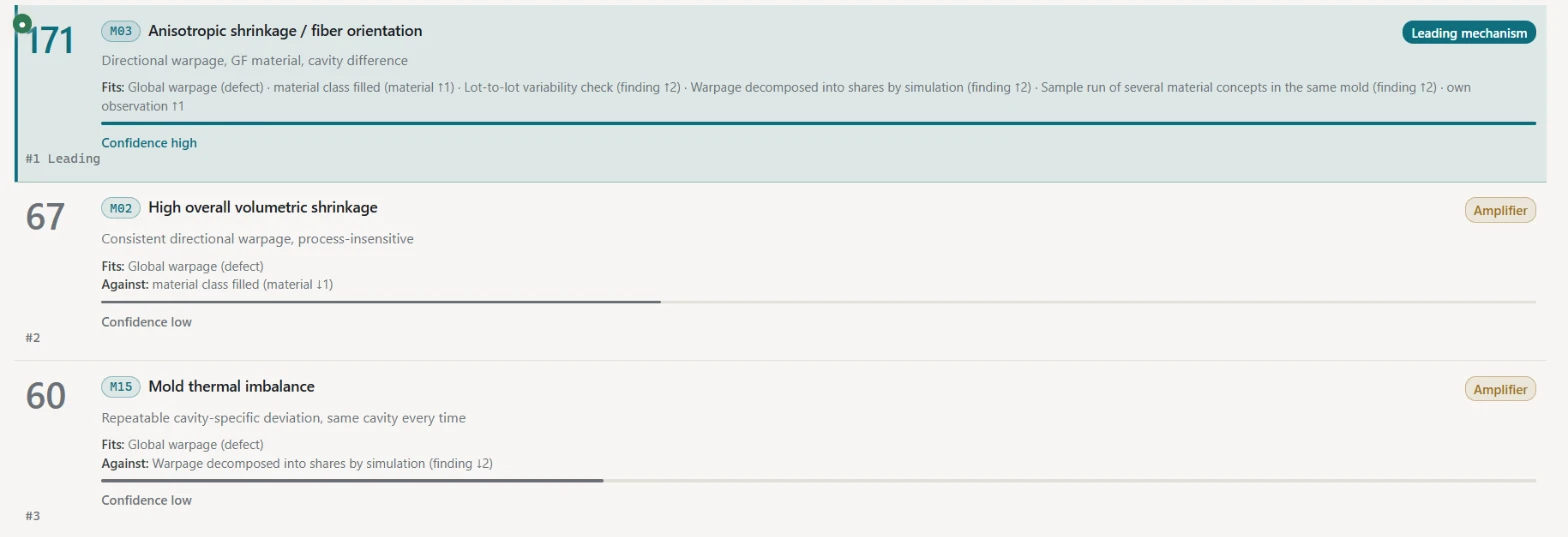
Lowered is not excluded. The simulation covers the calculated settings and a model of the mold, so the thermal imbalance stays in the workspace with a reduced value. A second own observation kept a share apart that the catalog places under the same heading: moving the gate in the simulation reduced the warpage by 0.4 to 0.6 mm for every material. Material and gate both carry the warpage, the material the larger part. The team worked on both in parallel.
Which option warps least was the obvious question. It was the wrong one.
The context decides what is possible
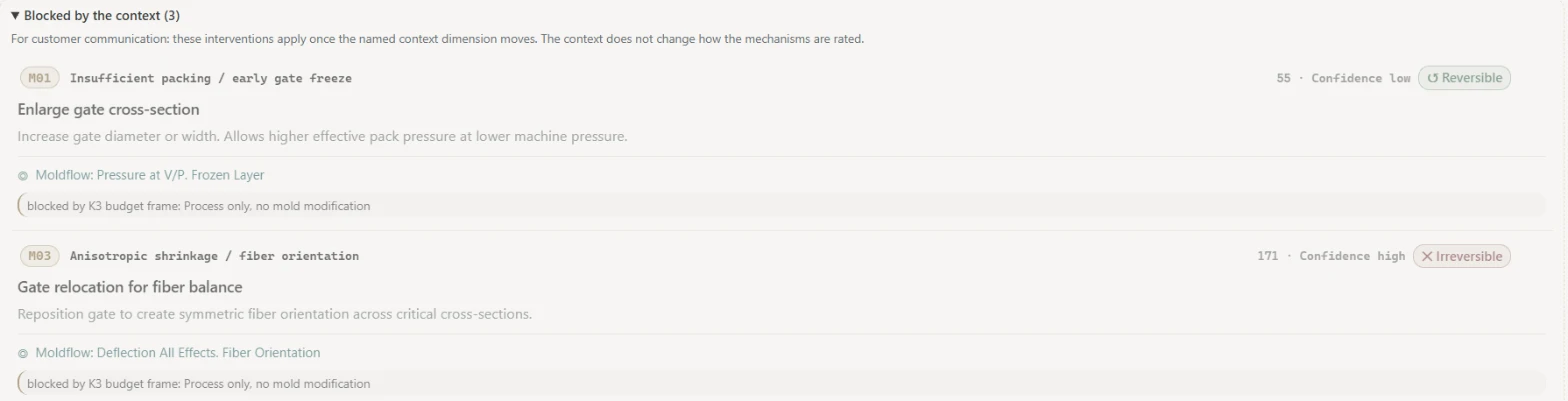
The context had been recorded at the start: pre-series, weeks to the audit, process only and no mold modification, and a field environment in which the open flap must not tear off under an impact load. In SEM Desktop, the context never changes how a mechanism is rated. It decides which interventions are available. A material switch is part of the process and stays possible; a gate relocation in the mold is blocked by the frame and remains listed, so the team can tell the customer under which condition it would apply.
Three options against the target
Calculated warpage from the simulation; the existing mold has a compensation of about 3.5 mm.
| A · PC-SAN-GF30, gate relocated | B · Long-glass PP-GF50, existing gate | C · Series material, gate relocated | |
|---|---|---|---|
| Warpage | 1.2 mm, the lowest | 3.5 mm, low and stable | 3.8 mm, scatter remains |
| Field environment | Misses the minimum tensile strength: out | Meets the tensile strength | Not the limiting point |
| Mold | Misses the compensation; all mold adaptations again | Matches the compensation; adaptations stay | Changes the fiber orientation the compensation was made for |
Two things decided it that no single warpage figure shows. The first is the field environment: a material that misses the minimum tensile strength drops out, however little it warps. The finding about it stays valid; its 1.8 mm against 4.2 mm with the series material still says that the material carries the warpage. The second is the target. A mold with a compensation needs a part that warps the same way, shot after shot and lot after lot, and by the amount the compensation expects. A part that is as straight as possible misses it as surely as one that scatters.
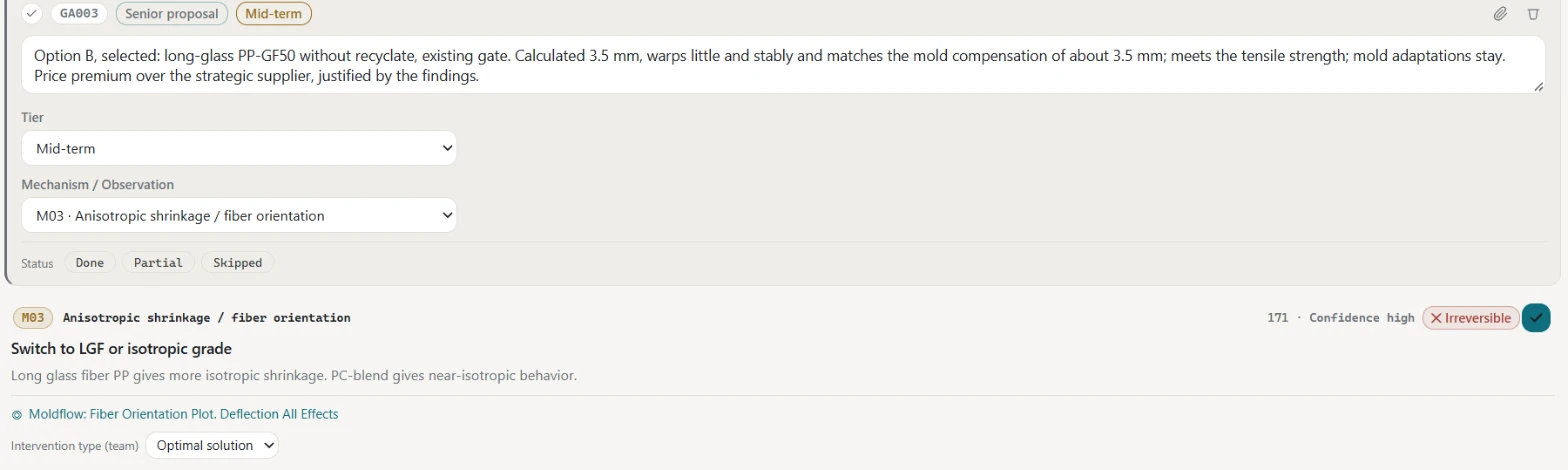
The long-glass grade met both: calculated 3.5 mm against a compensation of about 3.5 mm, stable warpage, the required tensile strength, and the existing mold with all its adaptations. In SEM Desktop it is the catalog intervention “switch to a long-glass or isotropic grade”, typed by the team as the optimal solution for the material mechanism, with the reasoning written next to it. The gate stays where it is, because the compensation was built for its current position.
What verification showed
The parts from the new material lay within the customer specification, and the customer’s measurement turned out well. The heat ageing of complete modules was still running when the customer closed the case after a phone call; the modules passed it. The parts have now run in series production for a year, without failures and within specification. That verifies the intervention, on the material mechanism and on the target the compensation set.
The record keeps apart when the case was closed and when the verification was in; whoever reads it later knows what was shown at which point. SEM Desktop does not make the decision. It keeps mechanisms, findings, context and interventions in one place, so that the decision can be followed and the next engineer can continue from it. The next part turns this record into what project management, quality and the customer need on one page.
Is a defect pattern holding up your launch or series production?
Describe part, tool and problem. The first assessment is free and without obligation.