
SEM before SEMPart 1
The holding time was right. The part still needed material.
A two-cavity cover with sink marks, a gate freeze measured at two seconds and a second mechanism at the gate. Two interventions, each verified on its own mechanism.
Ingo Konrad DentzIKAR Solutions OÜ · SEM AcademyOctober 2026Anonymized case under NDA
On one of our earlier projects, a cover molded in a two-cavity tool had sink marks on its visible surface. The holding time had been set by a gate-freeze study: part weight stopped rising once holding pressure was held for longer than two seconds, and that value had gone into the process sheet.
The measurement was correct. The question was why packing stopped while the part still needed material.
The original simulation had predicted a longer effective packing time, but it modeled a different geometry at the gate. In the tool, the gate sat on a dome, an auxiliary geometry on the core side, so the wall directly at the gate was at its thinnest. This section froze early and closed the packing path. Once it had frozen, a longer holding time could not push more material into the part.
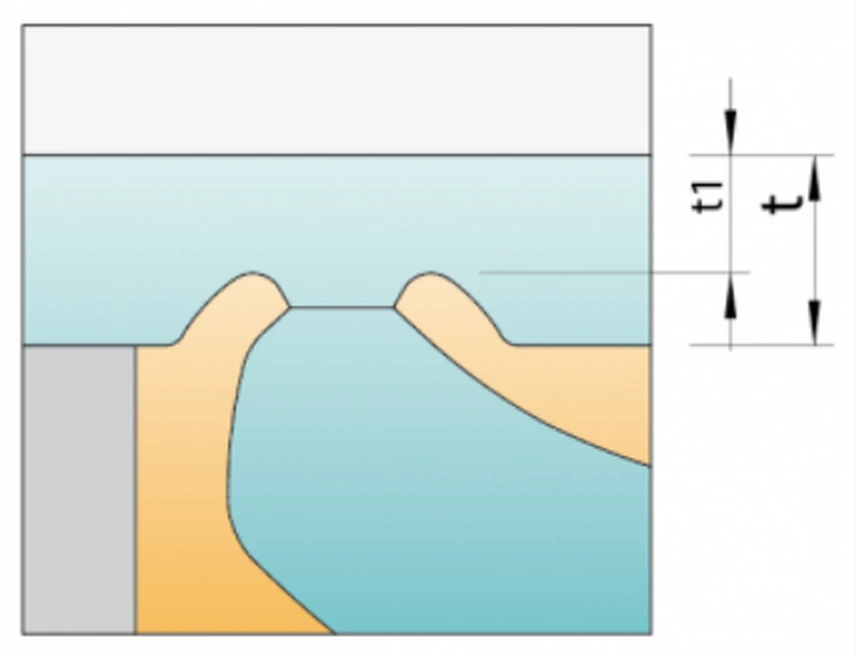
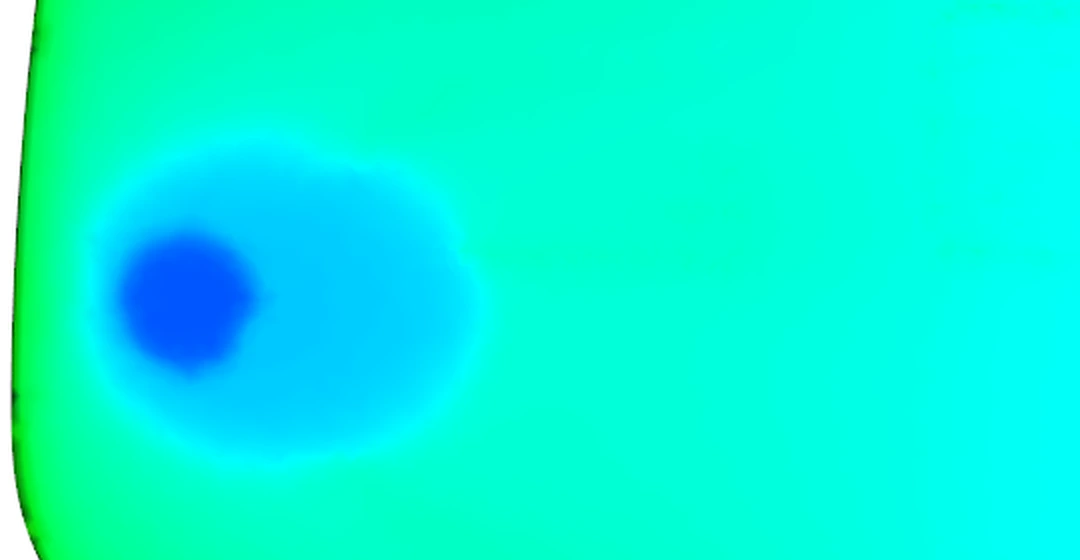
Anonymized; simulation shown without values.
We milled the dome off, repeated the gate-freeze study and set the holding time to suit the modified geometry. The longer holding time now reached the part, and the sink marks on the surface disappeared.
One mark remained: a shallow dent directly at the gate.
It had been there from the start. Among several sink marks it looked like one of them, and the soap-water film used for inspection smoothed it over; a stripe-light projector showed it clearly. Its location set it apart. The part is filled through a banana gate, a curved tunnel gate that breaks off during ejection. It had been built to drawing, but the drawing did not follow the design rules for this gate type, and the gate held the part with a high extraction force. As it broke off, it pulled the underside in, and the visible side sank above it.
We replaced it with a standard insert from a mold-components supplier, started at 1.8 mm and opened it step by step during sampling to 2.4 mm, so that the seal time suited the part and the extraction force stayed low. The dent was gone.
Findings and mechanisms
Mapped retrospectively in SEM terms. The project ran before SEM had a name; this is not a historical software record.
| M1 · Packing path closed at the gate | M2 · Pull during degating | |
|---|---|---|
| Symptom | Sink marks on the visible surface. | Shallow dent directly at the gate, recognizable once M1 was resolved. |
| Findings | Weight plateau from 2 s in the gate-freeze study; the simulation of the drawn geometry predicted longer packing; in the tool, the gate sits on a dome at the thinnest point. | Location at the gate under stripe light; gate not designed to the rules for a banana gate; high extraction force during ejection. |
| Intervention | Dome milled off. Optimal solution: eliminates the mechanism. | Standard gate insert, opened from 1.8 to 2.4 mm. Optimal solution: eliminates the mechanism. |
Two mechanisms in one workspace
I use this older case because it shows the working logic behind SEM, the Strategic Engineering Matrix. The method was developed from projects like this one; the case is mapped to it retrospectively.
In a live investigation, several mechanisms can carry the same symptom, and tooling, material and process work often run in parallel. The matrix keeps the mechanisms and the findings assigned to them in one workspace: what supports a mechanism, what speaks against it and what still has to be checked. Each new finding changes that standing. In the cover case, resolving the packing path did not close the investigation; it made the second mechanism visible. Working on several mechanisms in parallel is different from changing several process settings at once without a plan. Every trial still needs recorded conditions and a question it can answer.
Choosing an intervention depends on the situation at the plant. A tool correction may be technically right and still take longer than the next delivery allows.
SEM distinguishes three types. An interim intervention secures delivery while the mechanism is still open; it needs clear limits and monitoring. A robustness intervention widens the process window once the mechanism is known, within an operating range that has actually been checked. An optimal solution eliminates the mechanism. These are not stages to work through in order. Each option is assessed by its reversibility, feasibility, risk and effect on the mechanism, and the context decides: time to the next delivery, budget and who can approve the change. In the cover case, both corrections eliminated their mechanism, and the time to the next delivery allowed it, so no interim intervention was needed.
Each intervention was checked against its own mechanism. After the dome was removed, the repeated gate-freeze study had to show that packing now continued for longer. For the gate insert, the dent had to respond under comparable process conditions, with demolding observed directly. A part that looks better is an important observation; the check has to show that the response matches the physical explanation.
Verification on the mechanism
M1 · Packing path closed at the gateVerified
- Expected
- Without the dome, the gate freezes later and a longer holding time adds material.
- Checked
- Gate-freeze study repeated on the modified geometry; holding time set to the new result.
- Result
- Longer holding time takes effect; sink marks on the surface gone.
M2 · Pull during degatingVerified
- Expected
- With a lower extraction force, the dent disappears.
- Checked
- Comparison runs under comparable process conditions; demolding observed.
- Result
- Dent gone.
What project management and quality need
This is where the technical work becomes useful to project management and quality. They have to explain the situation to the customer, justify the next step and state what has been secured. The engineering record gives them that directly: the observed defect, the mechanisms and the findings that support them, the selected intervention, its verification, and the open points and limits. In SEM Academy we call this decision document the Decision Pack; SEM Desktop generates it as a final report or a one-page summary. How it is used in the customer meeting is the subject of a later part of this series.
SEM grew out of experience across more than 200 complex industrial projects. SEM Desktop holds the matrix and links findings, interventions and verification; in SEM Academy, we teach engineers to do that work. Another engineer should be able to pick up the case, follow the decisions and continue from the same record.
Is a defect pattern holding up your launch or series production?
Describe part, tool and problem. The first assessment is free and without obligation.